

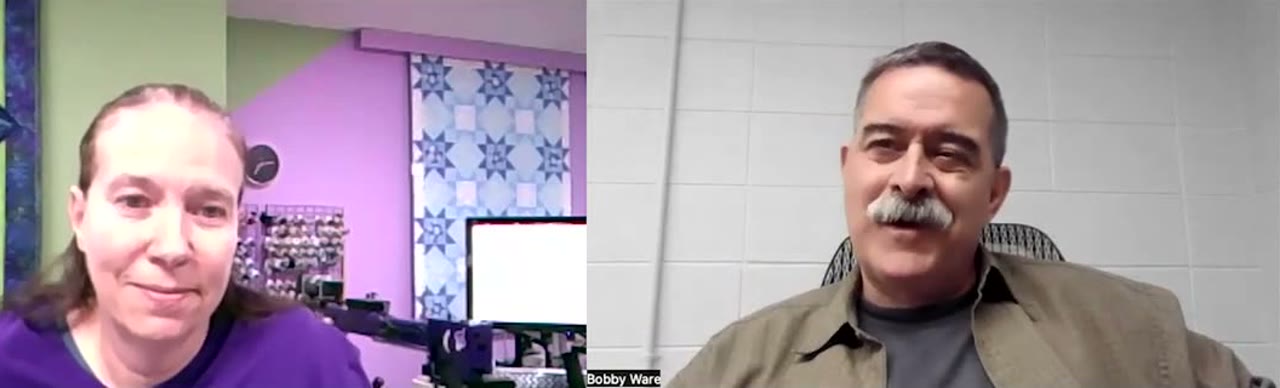
Key takeaways
- Karna charges 2¢ per square inch for edge-to-edge quilting, with thread included and a $40 minimum charge. Batting is extra, cut from the roll as needed.22:29
- She completes 855–900 customer quilts per year, running two Gammill Statler longarms nearly full-time.23:35
- Her average turnaround is 3–5 days, made possible by efficient workflow and minimal backlog.20:45
- Custom quilting is no longer offered due to the time required versus customer willingness to pay.21:52
- A clear intake process and proactive communication help avoid misunderstandings and ensure customer satisfaction.28:06
- Karna recommends starting with donation quilts at a reduced price to build skill and confidence.46:38
The numbers
| Metric | Value | Basis | Note |
|---|---|---|---|
| Pricing | |||
| Edge-to-edge rate | 2 ¢/sq in | 22:29 | Karna's stated rate for edge-to-edge; 2 cents per square inch |
| Thread and batting charges | Thread is included in the 2 cents per square inch rate; batting is charged separately by the amount needed, cut from the roll (Hobbs 80/20 or Quilter's Dream). | 24:33 | Thread included, batting extra; no thread/setup charge |
| Volume and capacity | |||
| Quilts per year | 855–900 quilts | 23:35 | 855 customer quilts in the last year, over 900 including store models; customer quilts only for this key |
| Backlog / waiting list | 29–30 quilts | 31:57 | Backlog reached 29-30 quilts during a machine outage; normally much lower due to fast turnaround |
| Turnaround time | 0.4–0.7 weeks | 20:49 | Stated turnaround is 3-5 days for customer quilts; stated in days |
| Edge-to-edge share of work | 100 % | 21:48 | Karna states edge-to-edge is almost all of her work; custom is rarely accepted |
| Time | |||
| Quilting hours per week | 45–54 hours | 20:33 | Shop open 10-5:30 M-F, 10-4 Sat; Karna arrives by 9am, often works extra if behind; estimate 7.5x6=45, up to 9x6=54 hours/week |
| Money | |||
| Annual earnings (est.) | $153,900–$162,000 | estimate | quilts per year x edge-to-edge rate x 9000 sq in (queen); at 45–54 hours a week |
| Effective hourly rate (est.) | $59–$75/hr | estimate | annual earnings (est.) / (45–54 hours a week x 48 weeks) |
| Equipment | |||
| Machine (model, throat, table) | Two Gammill Statler longarms: both Optimum 30-inch, one upgraded to Ascend, both on-site at the quilt shop. | 4:03 | Both machines are Gammill Statler, 30-inch throat, one with Ascend upgrade |
| Machine payback (stated) | 4 years | 2:33 | First machine paid off in less than 4 years from customer quilting |
| Number of machines | 2 | 11:01 | Runs two Statler longarms at the quilt shop |
| Business profile | |||
| Years in business | 17–18 years | 2:39 | Started quilting for customers in 2007; interview in 2024 |
17 other metrics were not covered in this interview
- Custom rate
- Queen-size price, edge-to-edge
- Queen-size price, custom
- Average price per quilt
- T-shirt quilt price
- Time per quilt, edge-to-edge
- Time per quilt, custom
- Mail-in share
- Hourly rate (stated)
- Annual revenue (stated)
- Worst year revenue
- Lifetime revenue per machine
- Machine cost
- Machine payback (est.) (have: annual earnings (est.) $153,900–$162,000; missing: machine cost)
- Studio size
- Years quilting
- Customers
What the numbers say
What the numbers say
The available figures show that this quilting business operates at a substantial capacity, completing 855–900 customer quilts per year.23:35 The shop runs two Gammill Statler longarm machines [[t=243, t=661]], with the owner working 45–54 hours per week.20:33 Turnaround is notably fast, at 0.4–0.7 weeks per quilt,20:49 and the backlog is usually low, with a spike to 29–30 quilts only during a machine outage.31:57 This suggests efficient throughput and workflow management.
Pricing is clearly stated only for edge-to-edge quilting, at 2 cents per square inch,22:29 with thread included and batting charged separately.24:33 Nearly all work is edge-to-edge (100%),21:48 so this rate applies to most jobs. Other rates (custom, T-shirt quilts, average price) are not given, limiting analysis of pricing diversity.
Estimated annual earnings, based on the edge-to-edge rate, quilt volume, and a typical queen quilt size, are $153,900–$162,000. This yields an effective hourly rate of $59–$75, assuming 45–54 hours per week over 48 weeks. These are estimates and rest on the stated quilt count, rate, and assumed quilt size; actuals may vary if quilt sizes or rates differ. The first machine was paid off in under four years from customer quilting revenue,2:33 but the original machine cost is not stated, so the payback calculation cannot be fully verified.
Overall, the business demonstrates high throughput and efficient use of equipment, with clear capacity and pricing for its core service. However, lack of detail on custom work, actual quilt sizes, and machine costs limits a more granular financial analysis.
How Much to Charge for Longarm Quilting: Karna’s Exact Numbers
When quilters search for ‘how much to charge for longarm quilting,’ they’re often looking for real-world numbers and rationale. Karna Lackey keeps it simple: she charges 2¢ per square inch for edge-to-edge quilting, which includes thread. Batting is charged separately, cut from the roll (Hobbs 80/20 or Quilter’s Dream), and there’s a $40 minimum charge for small quilts 22:29.38:11 She does not add a separate thread or setup fee, telling customers, “The thread’s included in that two cents. Obviously batting is not”.40:17
Karna’s pricing is shaped by the realities of her market. “Two cents is kind of the going rate in our area,” she explains.22:29 She’s transparent with customers about what’s included and what’s not, which helps avoid confusion or sticker shock. For custom quilting, she has stepped away entirely: “Our edge to edge is just so crazy. I just don’t have time for that… what I need for square inch on a custom, people just won’t pay it”.21:52 This clarity keeps her workflow focused and pricing transparent.
She also sets clear boundaries on what she will and won’t do: “It’s not a word I use very often around here, but I have learned to say it when it comes to this. They say the word custom, you say, get out. No, I just… I really just, I just tell people no”.22:51
“Two cents is kind of the going rate in our area.”
Building a High-Volume Quilting Business
Karna’s shop, Sew Into Quilts, completed 855 customer quilts last year, with total volume exceeding 900 when store samples are included.23:35 She runs two Gammill Statler longarms, both 30-inch Optimum models, in the front of her quilt shop, operating them six days a week. “They pretty much run full speed every day, six days a week,” she says.11:01
This high volume is possible because she and her husband work as a team: “Having two keeps me really busy. You know, just keeping them going and rolling and changing bobbins and things”.11:10 Her husband Jeff retired to help in the shop, handling prep work and assisting with the machines when quilts are flat enough.12:20
Karna’s journey to this scale wasn’t overnight. She started quilting for others in the evenings and weekends while working a full-time job, and remembers the milestone of her first 100 quilts in a year: “The first year that I actually quilted a hundred quilts, I thought that was like a really big milestone for me. I’m like, I did a hundred quilts this year”.5:13
The shop’s location in Hutchinson, Kansas, draws customers from a wide area, and Karna has seen the local market shift over time. Many longarmers, she notes, stop taking customer quilts once their machines are paid off: “A lot of the people that would do it for customers, once they got their machine paid off, they’re like, it’s I don’t have to do it for a business anymore. I can just put my quilts on it”.15:35 This has helped her business grow as others have left the market.
“They pretty much run full speed every day, six days a week.”
Workflow and Turnaround: The Secret to Customer Loyalty
Karna’s turnaround time is a key selling point: “We have about a three to five day turnaround on quilts”.20:45 Customers sometimes get a call the next day to pick up their finished quilt. This rapid pace is maintained by keeping both machines running during shop hours and, if necessary, working evenings or Sundays to catch up.21:01
She attributes her growth to this consistency: “I think quality and turnaround time is what’s really increased our business”.21:06 Even with a waiting list of 29–30 quilts at times, she avoids a large backlog, which she says would make her nervous: “We had, I think, 29… when we were down like 30 quilts and that just about sent me over the edge” 31:57.32:23
Karna’s workflow is highly organized. She and Jeff have a “ballet” of prepping, loading, and rolling quilts, winding bobbins, and pressing wide backs. “It’s just a continuous nonstop motion,” she says.12:11 If a machine is down for repairs, the difference is immediately felt: “When we were back down to one… it was not good”.33:46
She emphasizes that the shop is her life: “The quilt shop’s my life. It’s my business now. So, you know, we don’t have, you know, kids at home, no grandkids yet here. So, you know, basically I’m, this is my life for right now”.33:06
“We have about a three to five day turnaround on quilts.”
“Quality and turnaround time is what's really increased our business.”
Intake, Communication, and Handling Imperfect Quilts
Karna uses a clear intake process, including a form and collaborative selection of thread and pantograph patterns. Some customers want to choose every detail; others say, “You pick the design,” which makes her nervous. She always asks for preferences to avoid missteps: “At least tell me if there’s things you don’t like… does the quilt have a home?”.28:26
She never measures quilts in front of customers to avoid embarrassment if a top isn’t square. If she finds an open seam before loading, she fixes it herself; if she finds it mid-quilting, she flags it for the customer to hand-sew.41:45 Her philosophy: “I’m not the quilt police. I’m here to quilt your quilt. I’m not a judge. This isn’t a show”.39:43
Karna sees a wide range of skill levels among her customers, especially as more self-taught and younger quilters enter the hobby: “Some of our quilters, and we also see a lot of new quilters, which is awesome. We’ve got a lot of younger quilters. A lot of them are self-taught from YouTube and things like that”.39:12 She reassures anxious customers: “Your quilt doesn’t have to be perfect. I’m not going to tell you don’t”.40:00
When issues arise, such as a needle break that damages a quilt, Karna is proactive: “I’ve either reduced it or I’ve said, I just didn’t charge them for the quilting. So, you know, most everybody pretty much understands, you know, I mean, it’s a machine and things can happen”.27:13
“I'm not the quilt police. I'm here to quilt your quilt. I'm not a judge.”
What Karna Includes—and Excludes—in Her Pricing
Thread is included in the per-square-inch rate. Batting is charged by the amount needed, cut from the roll. She stocks both Hobbs 80/20 and Quilter’s Dream, and offers over 200 bolts of wide backs for sale.24:33
Binding is available but discouraged: “It’s not a business that I want to be in by any means so it’s priced accordingly. We still have a few people that you know have us do the binding but it’s not something I really want to do”.40:32
There is no setup or thread charge: “Nope. The thread’s included in that two cents. Obviously batting is not”.40:17
Karna also does a significant number of t-shirt quilts, both piecing them for customers and quilting those pieced by others. She prefers a collage style, using a lightweight stabilizer and half-inch seams pressed open: “We do the collage style… all of the blocks are finished four inch grid. And then we use stabilizer… it’s really lightweight and some people feel the shirts and they can’t even tell it’s on there”.25:36
Managing Growth and Avoiding Burnout
Karna’s business has grown steadily, with last year being her busiest yet. She admits the hardest part is simply keeping up: “The hardest part for me has just been keeping up. And if I have them quilted and I call them and they choose not to come get them, then that’s kind of on their side”.30:38
She avoids overcommitting by focusing on edge-to-edge work and maintaining a manageable queue. When one machine was down for repairs, the backlog jumped to 30 quilts, which she found stressful.32:23 She’s considered adding a third machine, but says, “I don’t know that the one or two of us can really keep three of them going efficiently. There’s no point in having three if one’s sitting there waiting on things”.33:57
Karna also takes precautions to protect customers’ quilts. When she quilted at home, she would store finished quilts in garment bags inside her washer and dryer during storm season: “If there was any threat of bad weather, I would… put them in my washer and dryer in the basement of our house till I got back home from camping. Because I thought if the tornado hit my house, maybe the washer and dryer might save the quilt”.31:16
She’s learned to say no when needed, especially to custom work, and to set boundaries that keep the business sustainable. “I really just, I just tell people no. It’s not a word I use very often around here, but I have learned to say it when it comes to this”.22:51
Advice for New Longarm Quilters: Start Small, Build Skill
For those starting out and wondering how to set prices or get experience, Karna suggests working with local donation quilt groups: “If you’re just starting and you’re like, I don’t feel comfortable doing quilts for others, there’s a lot of groups in town that do donation quilts… if you’re willing to do it at a reduced price or a lower price just to get your feet wet… I think that’s an awesome place to go”.46:38
She also emphasizes that not all customer quilts will be perfect, and part of the job is reassuring new quilters: “Your quilt doesn’t have to be perfect. I’m not going to tell you don’t”.40:00
Karna’s own learning curve was steeper than she expected, even with experience on a domestic machine: “When I first got the machine… I felt like I was pretty confident on my domestic machine, like this is going to be a cakewalk in the park for me… and then I waltzed across there. And I was like, holy cow, what did I just do? Because I’ve never seen anything look so bad my entire life”.16:29 She credits practice and taking on donation quilts for helping her build skill and confidence.16:52
She encourages new longarmers to be patient with themselves and to use the resources available today, from training videos to online groups: “It’s a totally different world now, isn’t it?”.17:58
“If you're just starting... there's a lot of groups in town that do donation quilts... I think that's an awesome place to go.”
Customer Service as a Differentiator
Karna credits her shop’s growth to service as much as speed: “You can buy fabric in a lot of places but you can’t always buy service so that’s our goal here is to try to provide excellent customer service”.43:15 She and her husband Jeff are known for their personal touch, with Jeff developing a following of his own for helping customers audition fabrics and offering friendly advice.44:33
“Every day is a great day at the quilt shop,” Karna says, reflecting on her transition from a corporate career to running her own business.37:51 She enjoys the autonomy and the ability to make decisions that directly benefit her customers: “For me, I mean, there isn’t a comparison because I can make decisions. I can affect change. You know, if something needs to get done, I can do what it needs”.37:05
The shop’s reputation has improved under her leadership, with a focus on friendliness and helpfulness: “We had to kind of make a turnaround because the shop prior maybe had, you know, not as friendly a reputation as it probably should have… we have a great bunch of people that work here and… people are appreciative of the help they receive”.43:00
Karna’s approach to customer service is flexible: some customers want to browse alone, while others want hands-on help. Jeff, in particular, has become a favorite for his willingness to bring bolts of fabric to customers and help them audition options: “He’s kind of got his own set of groupies just because… he brings all, you know, bolts of fabric up and what do you think about this and he’s pretty, he’s really good with color”.44:52
Questions this interview answers
How much should I charge per square inch for longarm quilting?
Karna Lackey charges 2¢ per square inch for edge-to-edge quilting, which includes thread. She also has a minimum charge of $40 for small quilts. Batting is charged separately by the amount needed, cut from the roll 22:29.38:11
Do you charge extra for thread or setup in your quilting business?
No, Karna includes thread in her per-square-inch rate and does not charge a separate setup fee. Batting is the only common extra charge, based on the amount used.40:17
How do you keep turnaround time so fast in a quilting business?
Karna maintains a 3–5 day turnaround by running two longarm machines full-time, working with her husband to keep workflow efficient, and focusing exclusively on edge-to-edge quilting to maximize throughput 20:45.11:01
How do you handle customer quilts that aren’t perfectly pieced?
Karna never measures quilts in front of customers to avoid embarrassment. If she finds issues like open seams, she fixes them herself when possible, or flags them for the customer if found during quilting. She reassures customers that her job is to quilt, not judge 41:45.39:43
What advice do you have for new longarm quilters setting prices?
Karna recommends building skill and confidence by quilting donation quilts for local groups at a reduced price before taking on customer work. She emphasizes the importance of practice and gradual growth.46:38
Source
This article was written from Episode 49 of Quilting Business Success with Karna Lackey. Quotes are verbatim and link to the moment in the recording. Full transcript · Markdown version.